
How TS16 TuffStudds cut CAT 815 wear costs by 80%
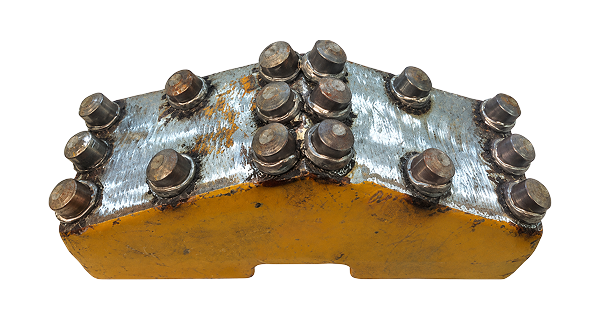
A site preparation contractor in Colorado Springs was getting roughly one year from each set of caps on its CAT 815 Compactor. The machine worked in rock, rocky soil, and crushed concrete, wearing through two applications of hard-facing before the caps had to be replaced.
In July 2013, the contractor installed a new set of caps protected with TS16 TuffStudds. More than four years and 4,000 operating hours later, those same caps were still in service.
The change reduced the contractor’s four-year wear costs from approximately $86,000 to $19,000—a savings of more than $67,000.
Key takeaways
- 80% lower wear costs
- More than $67,000 saved on one machine
- Over four years of service from one set of caps
- 4,000 documented operating hours
- No replacement caps or additional hard-facing required
One year, two rounds of hard-facing
A CAT 815 uses 160 caps across four wheels. As the machine travels over the ground, the caps create the concentrated pressure needed to compact the material below.
In this application, the abrasive conditions made those caps a recurring maintenance problem. The contractor installed a new set every year and applied hard-facing as soon as the caps were welded onto the machine.
After approximately six months, the hard-facing was gone and had to be applied again. Six months later, both the second application and the underlying caps were worn out.
Over four years, that meant buying four complete sets of caps and manually hard-facing all 160 caps eight separate times. The total cost came to approximately $86,000, not including the disruption of repeatedly taking the machine out of service.
Switching the CAT 815 to TS16
For the new set, 16 TS16 TuffStudds were installed on each cap—2,560 studs across the entire machine.
The local distributor completed the stud welding on a workbench and shipped the finished caps to the contractor on a pallet. The contractor did not need to purchase a stud welder or change its normal installation process. Its team simply welded the pre-studded caps onto the existing risers.
The complete set of new caps with installed TuffStudds cost approximately $19,000.
Still working after 4,000 hours
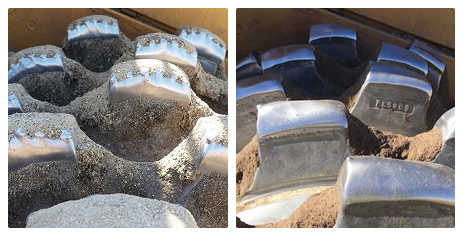
When the caps were inspected in June 2015, the machine had completed 2,500 operating hours. Material had collected between the studs, creating a protective dead bed across the cap surfaces.
The caps were inspected again in March 2018 after reaching 4,000 hours. More than four years after installation, they were still in service without replacement or additional hard-facing.
Why the caps lasted longer
The TS16 pattern traps rock, soil, and crushed concrete between the studs. That retained material forms what we call a dead bed.
Instead of continuously grinding against the steel cap, incoming material wears against the trapped material already covering it. The close spacing between the studs helps keep that layer in place and prevents clear wear channels from developing across the cap.
In this case, the dead bed helped one set of caps do the work that previously required four sets and eight hard-facing applications.
Over four years, the contractor spent approximately $19,000 instead of $86,000. That is more than $67,000 saved on a single CAT 815 and a reduction in wear costs of 80%.
Every application is different, but the goal is the same: keep equipment working longer and reduce the time and money spent replacing worn components.
Talk to the TuffStudds team about your wear application.